
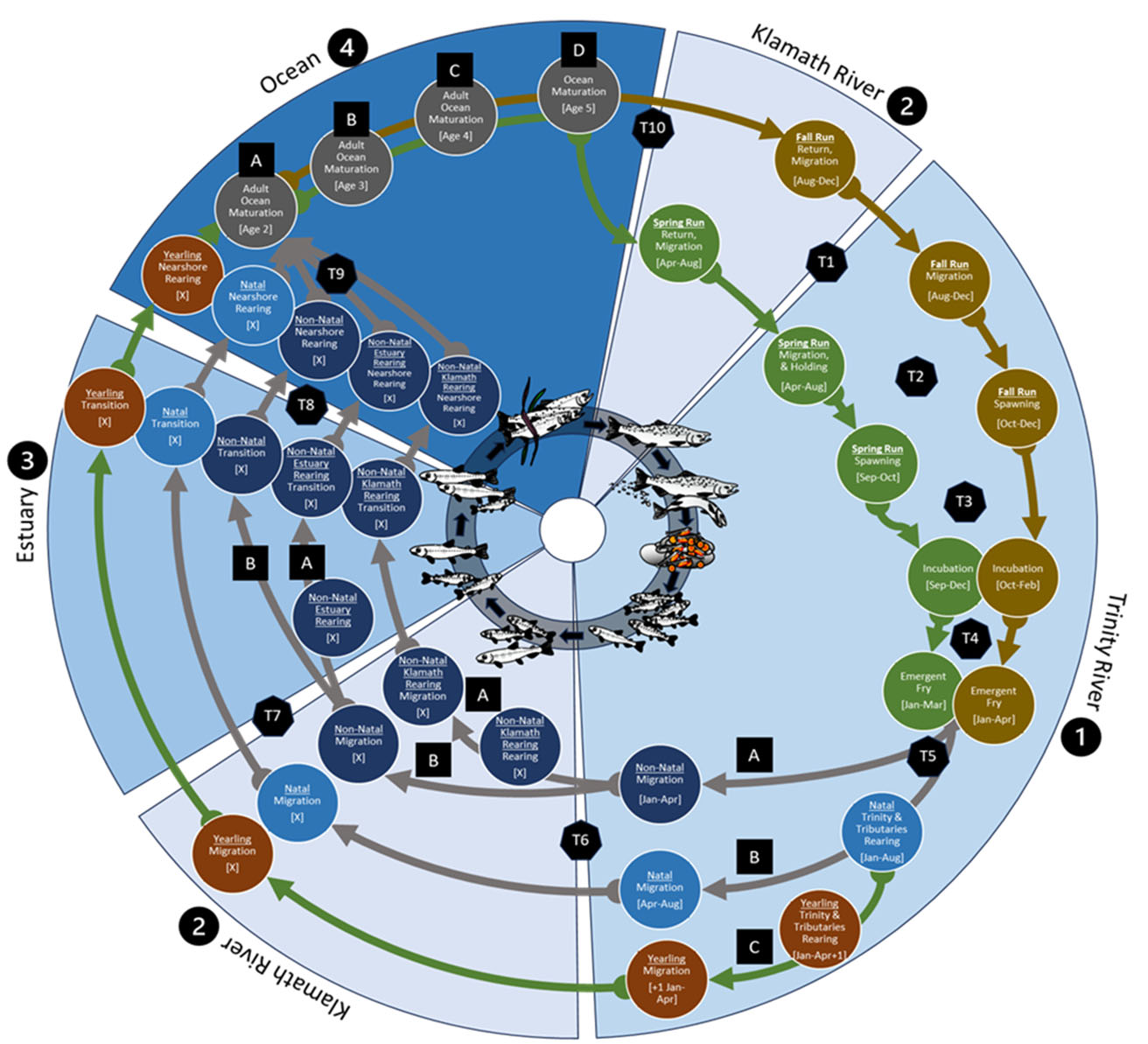
The Trinity Management Council convened in a special meeting this past August to hear a presentation regarding the completed Limiting Factors Analysis (LFA). The LFA was conducted by Cramer Fish Sciences a contracted third party by the Trinity River Restoration Program. Participants from multiple agencies and organizations joined to review the findings from this two-year study which included the development and functionality of a new lifecycle model while also identifying what limiting factors are the most pervasive for both fall and spring runs of Chinook in the Trinity River system.
Presentation Background
As the Program has accumulated new data on fish populations, it became clear that a fresh assessment was needed to update a previous limiting factors analysis prepared for the TRRP in the 1990s. Primarily juvenile Chinook habitat was identified as the main limiting factor for the population, yet as Program restoration actions have shown an increase in juvenile populations we have yet to also see a correlating incline in adult populations. The desire to understand what additional factors might be leading to the mismatch between juvenile and adult returns led to a multi‑phase contract with Cramer Fish Sciences to design and implement a comprehensive lifecycle model for both spring and fall runs of Chinook Salmon. The work included constructing the model, running diagnostic tests, and generating findings to support restoration decision‑making.
Model Structure and Approach
The lifecycle model tracks Chinook Salmon generations through spawning, emergence, juvenile rearing, downstream migration, estuary transition, marine survival, and adult return. Each stage is treated as a “checkpoint” shaped by survival, size, timing, habitat capacity, temperature, and environmental conditions. The presenters emphasized:
The model is diagnostic, not predictive
It examines relationships and directional changes rather than exact numeric outcomes.
Assumptions were carefully documented
Drawing from Trinity‑specific data where available and surrogate systems or expert opinion when necessary.
Scenarios allow “what‑if” testing
Such as modifying harvest rates, changing temperatures, increasing rearing habitat, or adjusting gravel size.
Key Findings from Cramer Fish Sciences
The results identified several priority limiting factors affecting Chinook Salmon recovery and each identified factor was rated with an impact level.
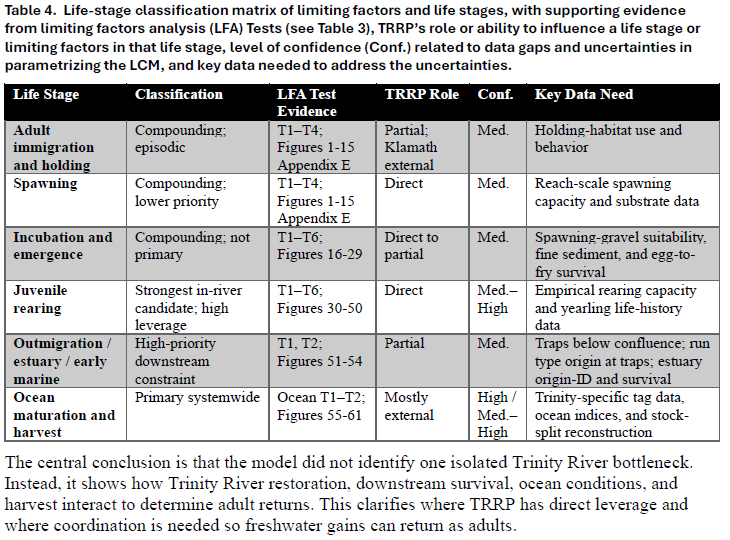
Scenario Demonstrations
Presenters walked through examples demonstrating how scenario adjustments change population outcomes:
- Increasing harvest alone results in steep declines in adult returns.
- Improving rearing capacity and temperature can offset harvest increases, returning adult returns to baseline levels.
- Scenarios showed how river conditions may affect juvenile timing and size distribution, survival, and eventual adult returns.
- Scenarios illustrated the importance of producing larger, well‑conditioned juveniles who migrate at favorable times.
Implications for Management
The analysis suggests recovery requires coordinated improvements across multiple life stages. Recommendations included:
- Prioritize investment in juvenile rearing habitat, temperature management, and monitoring to refine uncertainty in key processes.
- Use the model to evaluate restoration actions, flow decisions, and monitoring design before major investments.
- Coordinate with downstream, estuary, ocean, and fisheries partners, as many limiting factors lie outside TRRP’s direct control.
- Employ the model as a shared decision‑support tool, enabling cross‑agency scenario testing and long‑term adaptive management.
Transition to Program Ownership
Cramer Fish Sciences delivered the full model, graphical interface, documentation, and supporting data. The TRRP will now integrate the tool into planning, train personnel, and continue refining the model as new monitoring data becomes available. The Trinity Management Council also discussed revisiting next steps in upcoming meetings.