
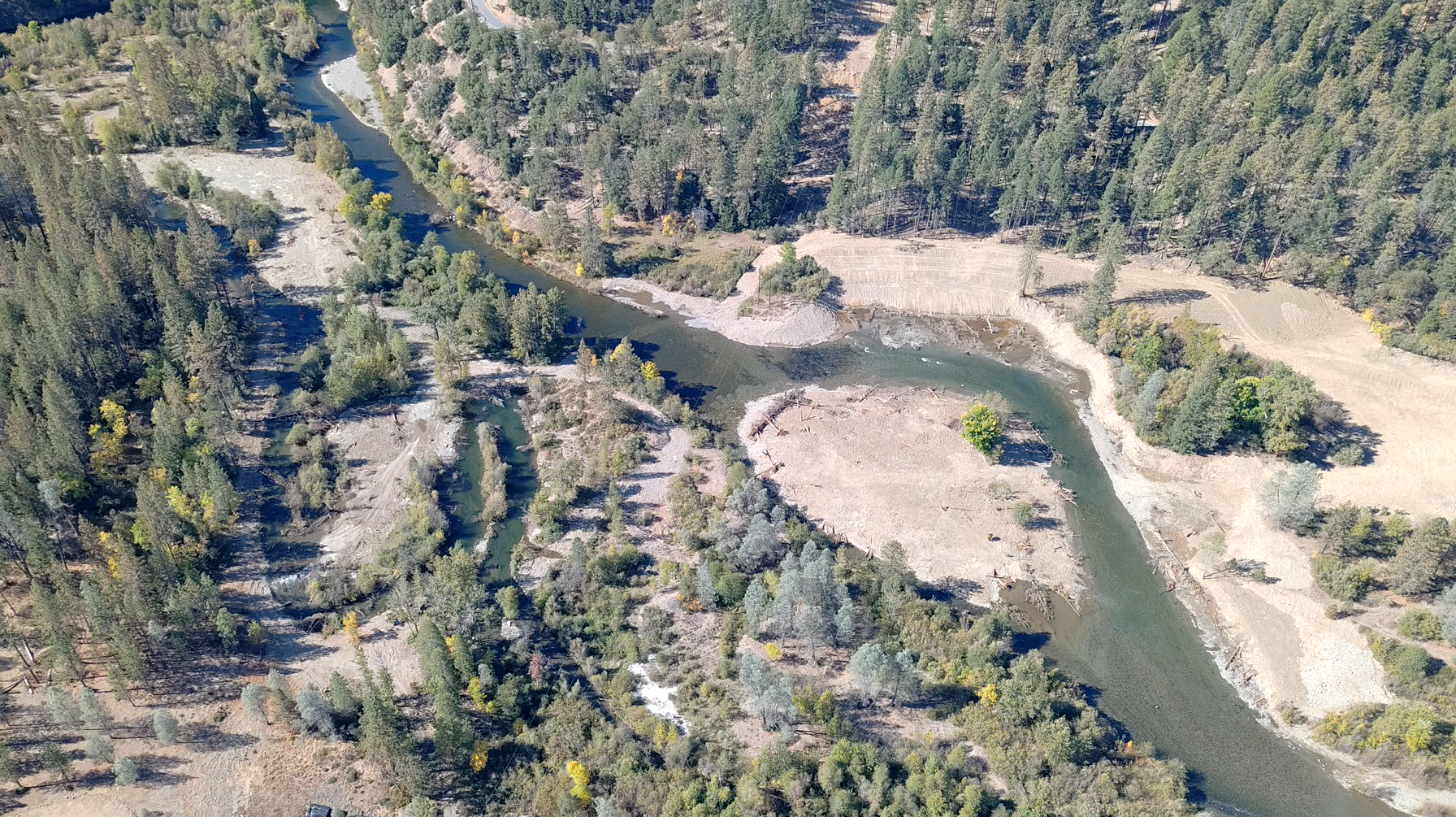
Lewiston, Ca. – The Yurok Tribe Construction Corporation completed civil construction at the Sawmill Gravel Processing Site Channel Rehabilitation Project the week of September 21. Hoopa Valley Fisheries Department re-vegetation crews remain at work and re-vegetation will continue until complete.
Project Timeline
Rehabilitation to improve rearing habitat for young salmon and steelhead began June 22 and civil construction completed on Sept. 25. Work primarily focused on the partial decommission of a long-term gravel processing site leaving the area in an ecologically beneficial state as well as improving habitat for juvenile salmonids. Hoopa Valley Tribe Revegetation crews will resume revegetation the week of Sept. 28. Neighbors may notice temporary truck traffic, some dust due to straw and seed blowing and limited construction noise during work hours. The revegetation crews will be crossing the river with machines to seed in-river features until Oct. 15.
Disturbances will be limited to active construction periods, Mon.– Fri., 7a.m. to 7p.m. Crews are authorized to work on Saturdays, but are as necessary and Saturday work will likely be infrequent.
Please contact us with any questions: (530) 623-1800
Public Scoping: December 4, 2023 – December 17, 2023 (complete)
Draft EA for Public Comment (30 day period): May 2 – May 31, 2024 (complete)
Final EA and Decision: July 24, 2024 (complete)
Implementation | Civil Construction: Summer 2025 – Fall 2026 (complete)
Implementation | Revegetation: Fall 2026 – Fall 2028
Project Summary
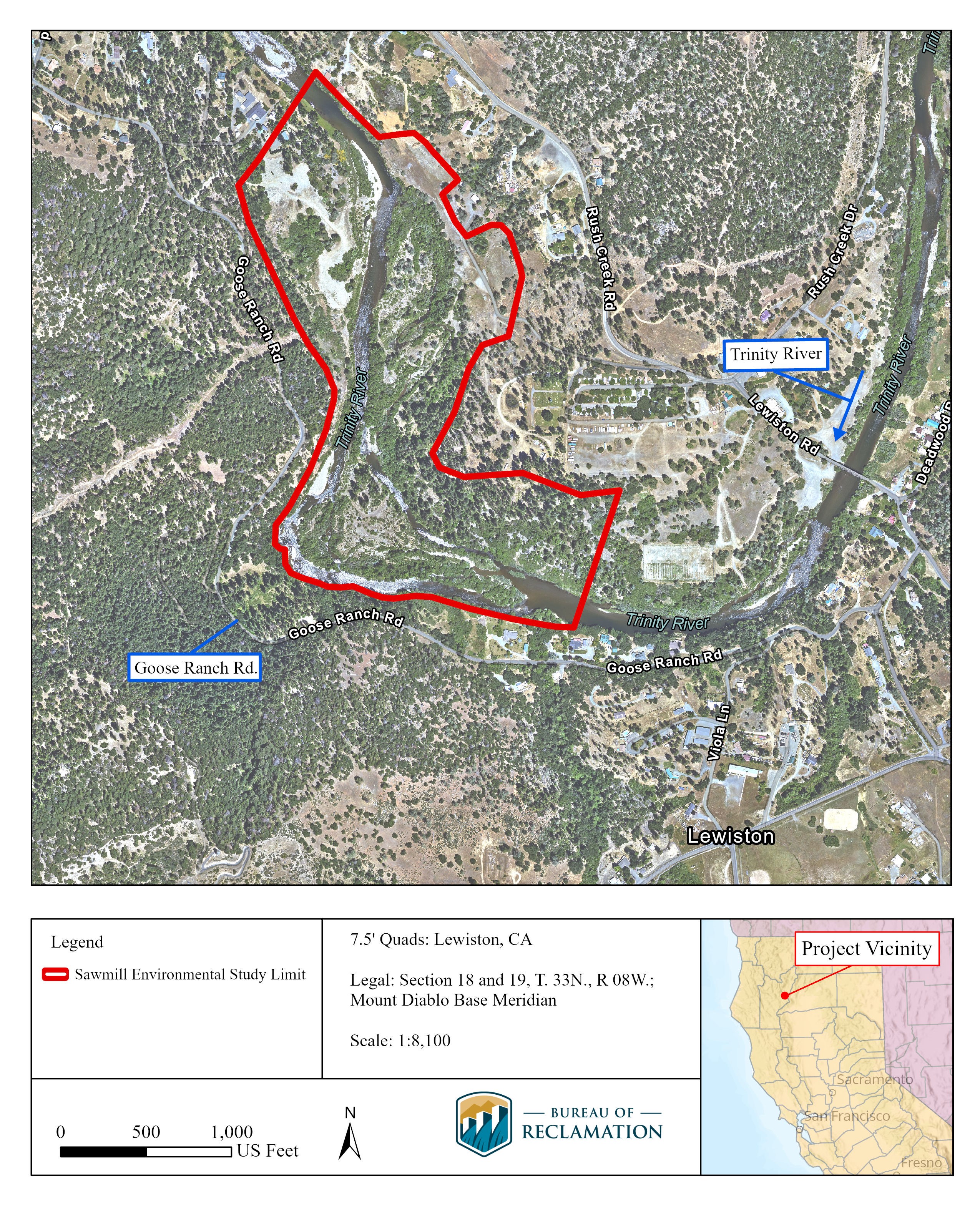
Located in Lewiston between river miles 108 and 110 is the location of the Sawmill Gravel Processing Site Rehabilitation Project. The project area boundary encompasses 75.5 acres of land, of which 62.5 are controlled by the Bureau of Land Management, six acres owned by the State of California, and the remaining seven acres are comprised of nine private parcels. This location was the site of a previous rehabilitation project in 2009 and has continued to be utilized as a sediment processing site for the Program due to its large supply of dredger tailings. Sediment processed at this site is used for channel rehabilitation and sediment augmentation.
By 2019 many of the site’s tailings piles have largely been processed down to a point that the surfaces could potentially be reconnected to the river. The major access routes for the project site will be Rush Creek Rd. on river right and Goose Ranch Rd. on river left.
- The current design models an increase in fry capacity summed over the range of frequent winter flows (300 to 1,000 cfs) by 91% over existing conditions. Presmolt Capacity summed over that range of discharge is modeled to increase by 85%.
- Between the most common baseflows between 300 to 450 cfs, fry and presmolt capacity is modeled to increase by 132% and 125%, respectively
- A large proportion of the material excavated during construction of this project will be staged for future processing to produce gravel and other geologic materials needed for rehabilitation activities elsewhere along the Trinity River.
- Estimated cut volume is 94,135 yd3 and the fill volume is 95,345 yd3
The figure below shows the Sawmill project activity areas.
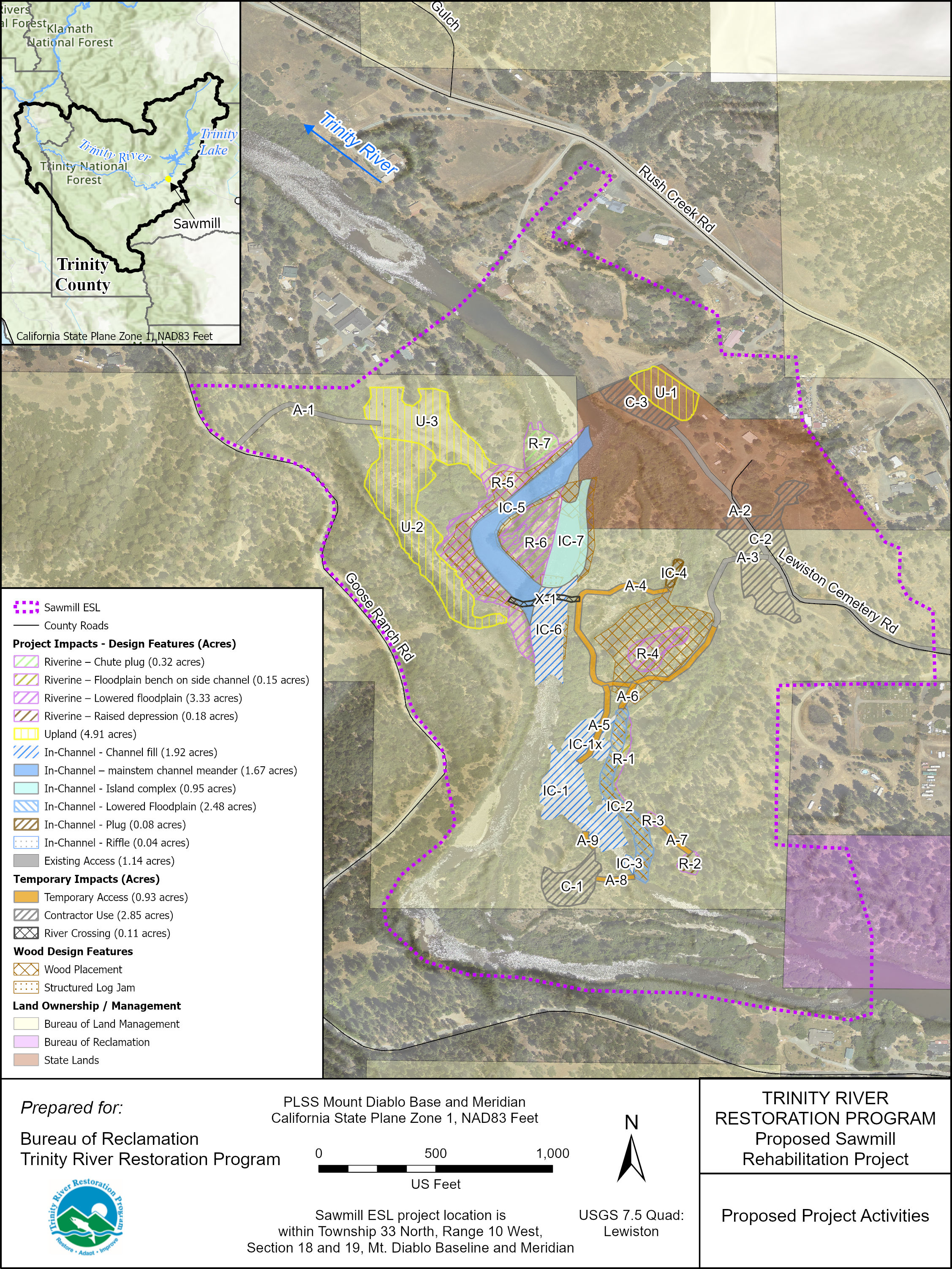
Sawmill Project Goals and Objectives
A primary driver of rehabilitation work in the Sawmill area is the need to partially decommission a long-term gravel processing site in a way that leaves it in an ecologically beneficial state. In keeping with the general programmatic goals of the TRRP, this means that the project design should strive to:
- Increase the quality and availability of rearing habitat for juvenile salmonids over a wide range of discharges.
- Increase the extent and frequency of floodplain inundation.
- Promote fluvial processes such as cut and fill alluviation.
- Maintain and improve existing adult holding habitat, particularly at Burner Hole.
- Promote the development of healthy, diverse riparian vegetation.
- Increase the supply of large wood available to the river.
Possible Local Disturbances
- Highway-legal haul trucks would make deliveries of equipment, large wood, plants, and other needed materials during work hours using existing roads. This may cause road delays.
- Nearby residents may experience noise commensurate with the use of haul trucks and heavy construction equipment, such as bulldozers and excavators during business hours.