
By: Kiana Abel, Public Affairs Specialist – Trinity River Restoration Program
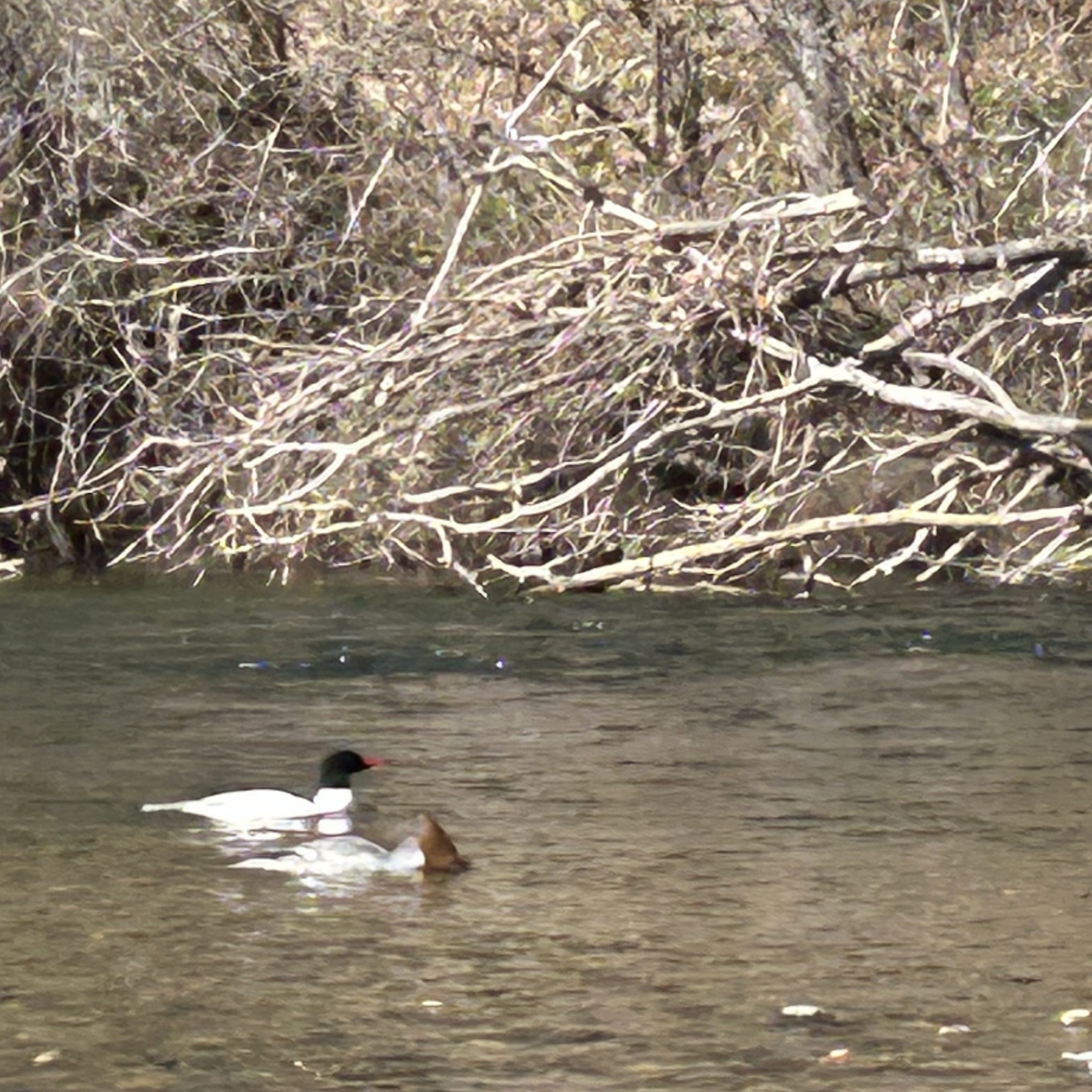
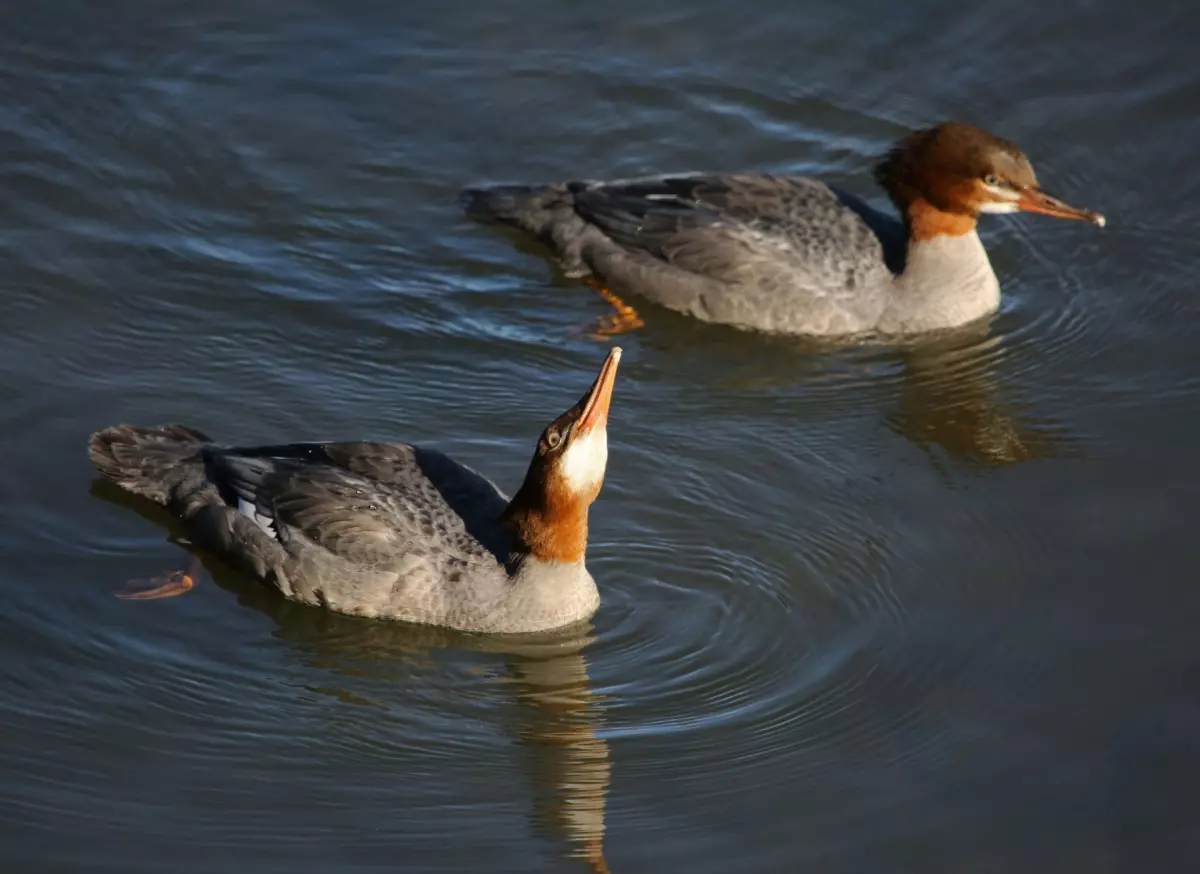
The Common Merganser (Mergus merganser) is, as the name suggests, very commonly seen when travelling the Trinity River corridor. Although common, they are striking when encountered. Males are bright white with dark green heads, while females wear elegant gray bodies with cinnamon-colored crests.
Both are unmistakable silhouettes gliding low over the water or“snorkeling” (swimming on the surface but with their heads underwater, looking for food) along the shallows.
Photo: Mergansers swimming in the Trinity River this past March. The female is shown “snorkeling” for food. [James Lee, Trinity River Restoration Program]
Beyond their striking appearance, mergansers may also be telling us something important about river ecology – especially when it comes to further understanding the early life stages of Trinity River salmon.
Life on the Trinity: A River Tailor-Made for Mergansers
Common Mergansers specialize in catching fish, and the Trinity River offers an exceptional winter buffet. With an abundance of young salmon available and with 60 years of consistent slow and clear winter flows, merganser population have benefited from perfect conditions for spotting and pursuing prey during the those months.
Their diet on the Trinity likely includes, mussels and salamanders but mostly they feed on a wide variety of fish, most notably, Chinook salmon fry. While young ducklings eat aquatic insects, adult mergansers may swallow a fish up to a foot long – check out this awarded photo from the Autubon Field Guide.
Mergansers are excellent predators, feeding by dipping their heads underwater while swimming, scanning the riverbed for juvenile fish.
A Growing Question: How Many Salmon Do They Eat?
Although common mergansers are a natural and important part of the Trinity River ecosystem, fish biologists have long wondered how significant their predation might be on young salmon and if that balance were out of sync due to low winter flows.
Two decades ago, Redwood Sciences Laboratory biologist Dr. C.J. Ralph offered a rough, informal estimate for the Trinity River: mergansers might consume millions of Chinook fry each year, given the combination of abundance and the seasonal availability of small, vulnerable salmon fry.
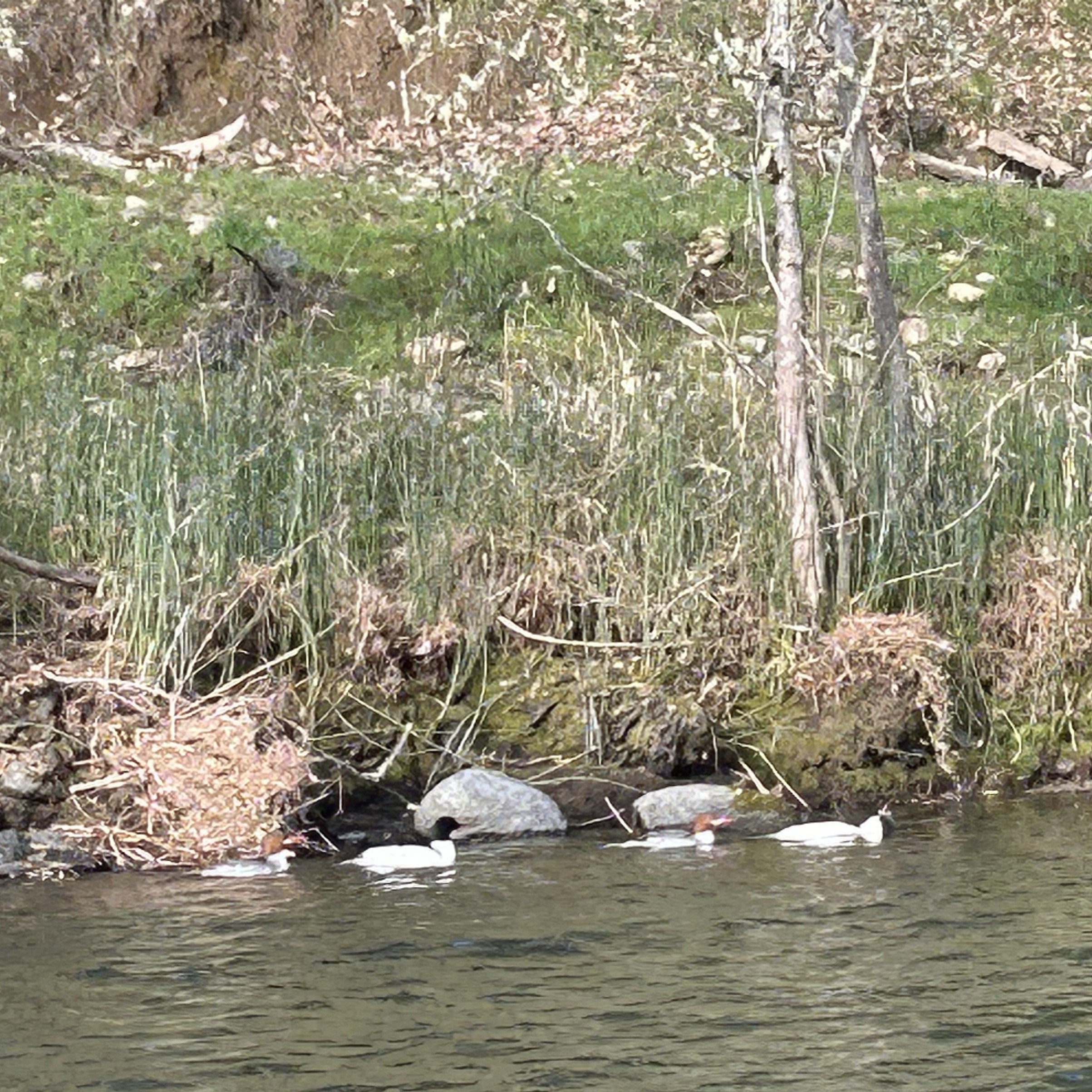
Recently, Trinity River Restoration Program staff revisited this question. A preliminary late winter float on the river counted 45 mergansers in just 6.2 miles—about 7.3 birds per mile. If that density were similar across the full 40-mile restoration reach, the river may host around 290 mergansers during peak fry emergence.
Using moderate assumptions from scientific literature – if about 450 fry are consumed per bird, per day (in prime conditions) – predation could reach into the millions over a two-month period.
While this estimate is intentionally conservative and includes many uncertainties, it begs the question – have mergansers benefitted from past flow management and preyed on Trinity River juvenile salmon at an unnaturally high rate due to managed conditions?
A Potential New Monitoring Effort: Counting Birds to Understand Fish
To explore this idea, scientists are considering a Before After Control Impact (BACI)-style study:
- Measure merganser abundance during low, clear 300 cfs winter flows
- Repeat surveys when flows are elevated (500–3,000 cfs)
- Compare both to a stable flow control reach
A simple float survey by TRRP staff in March provided a primary snapshot. Additional surveys during variable flows will begin building the baseline needed for a robust analysis.
This effort is still in its infancy, but it reflects growing collaboration among partners interested in fish ecology, bird behavior, and flow management.
Could Mergansers Be a Clue to Where Young Salmon Are?
An especially creative idea emerging from early discussions is that mergansers might help answer another long-standing question: Where are Chinook fry distributed along the river during their first weeks of life?
Because mergansers concentrate where food is most dense, their distribution may mirror fry distribution. This could provide:
- A new, low-impact way to monitor fry movements
- Insights between emergence and lower-river screw trap detection
- A broader understanding of habitat use during early rearing
In this way, mergansers might serve not only as predators, but also as bioindicators helping us better understand the juvenile salmon life cycle.
A Bird Worth Appreciating
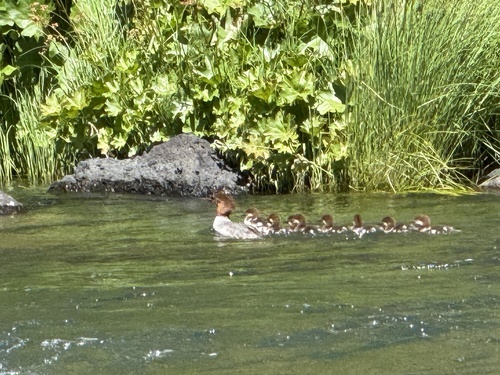
Despite their appetite, Common Mergansers are charismatic, lovely to see and ecologically important. They are one of the few waterfowl species that nest in high tree cavities, often returning year after year. They are agile swimmers, attentive parents – often adopting into their clutch and are stunning birds to observe.
Their seasonal presence on the Trinity River reflects both the river’s biological richness and the complex relationships among species that depend on it.
As the season continues, keep an eye out for these impressive divers, and stay tuned as scientists work to better understand the role they play in the story of Trinity River salmon and flow management.
References
- Common merganser – Wikipedia
- Common Merganser | Audubon Field Guide
- Common Merganser (Mergus merganser) | U.S. Fish & Wildlife Service
- Cornell Lab of Ornithology – Birds of the World: Common Merganser (Mergus merganser)

Kiana Abel, Public Affairs Specialist
As Public Affairs Specialist for the Trinity River Restoration Program, Kiana manages external communications, media relations, and stakeholder outreach. She acts as a liaison between program initiatives and the public, transforming technical findings into compelling narratives that promote understanding of restoration initiatives on the Trinity River. Kiana holds a Batchelor’s in Art History, has spent most of her career in marketing and is focused at the TRRP on bridging the gap between public awareness and resource restoration and management.