
March Forecast – “Dry” with potential for “Normal”
Surveyors from the Watershed Training and Research Center are encountering minimal snow pack and melt in the Trinity Alps.
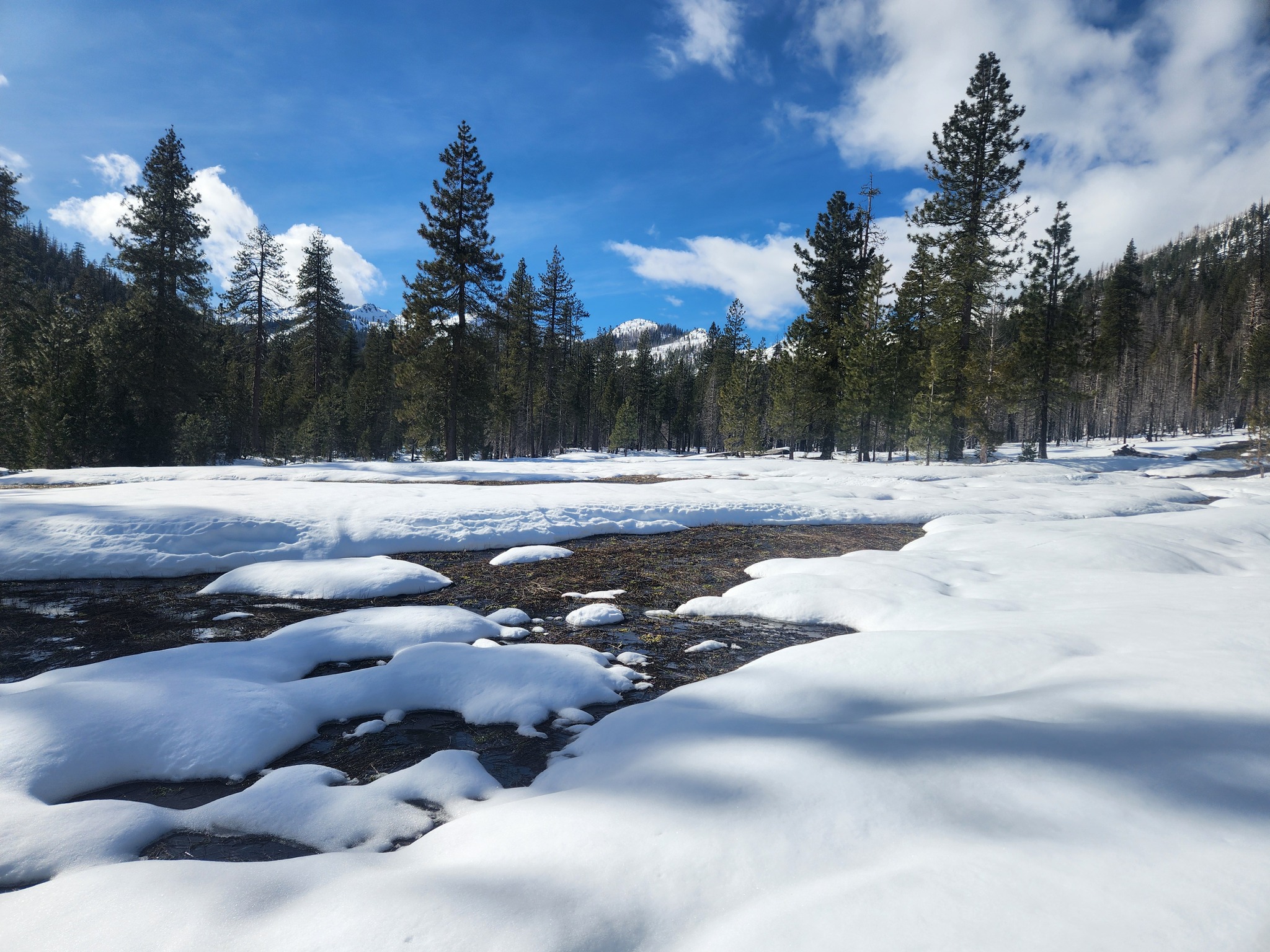
Snow Survey Results (from February)
“This was one of the wettest snow surveys in recent history for our crews.” Josh Smith, Watershed Stewardship Program Director described. “It rained at 7,000′ and every ephemeral swale had running water. It was a maze of streams running through the meadows and forests that made travel difficult and time consuming. We hope that the temps drop and/or we get some more snow storms in the near future!”
From a WRTC Facebook Post: February 2026 statistics, with February 2025 measurements in parentheses for comparison.
| Bear Basin | Red Rock Mountain | Shimmy Lake | |
| Snow height | 40″ (80.5″) | 41″ (101.5″) | 51.5″ (99″) |
| Snow Water Equivalent | 16.5″ (32.5″) | 16″ (43.5′) | 21″ (42.5″) |
Trinity River Watershed Mar. Forecast
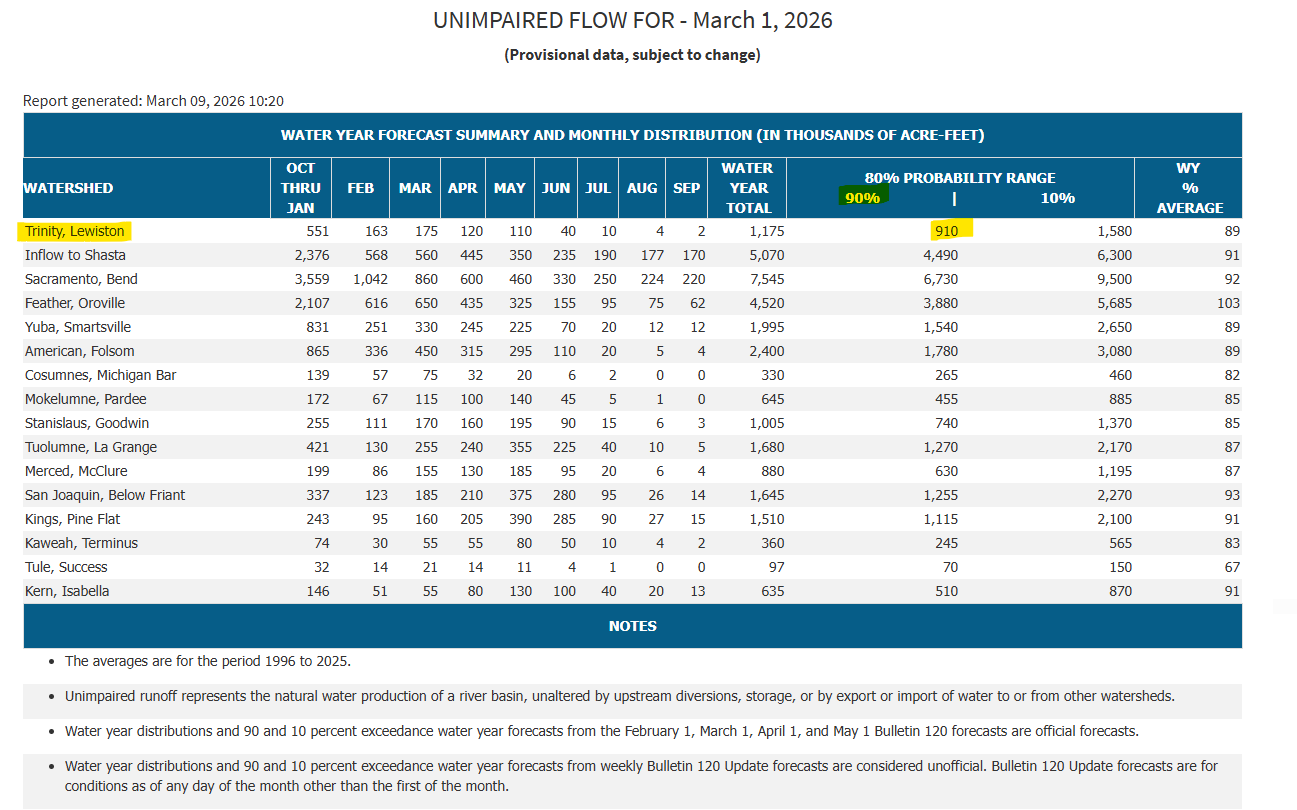
The volume of environmental flow releases for the Trinity River Restoration Program’s Wet-Season Baseflow Period (Feb. 15-Apr. 14) are determined by a conservative monthly inflow projection for Trinity Reservoir from the California Department of Water Resources (90% B120) in February, March with the final determination in April.
The current period within the Trinity River Restoration Program environmental flow management is the Wet-Season Baseflow Period. The California Department of Water Resources March 90% B120 declaration was published on Mar. 9 as “Dry” with the 90% determination at 910,000 acre feet.
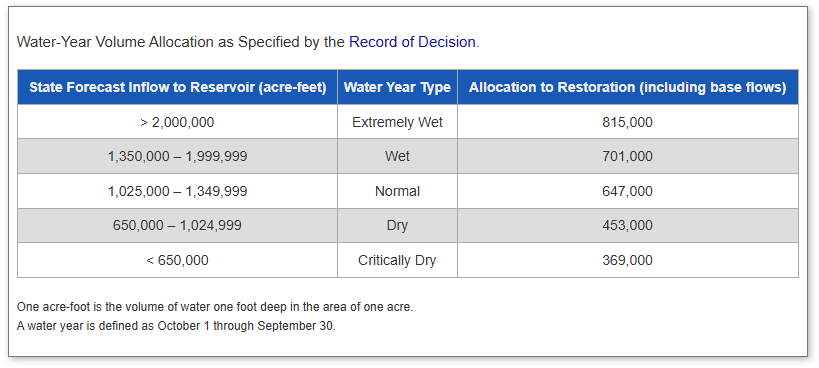
The Program’s Water-Year Volume Allocation as specified by the Record of Decision is outlined in the table below. The far left column is the threshold amount of state forecasted inflow in the Trinity Reservoir listed in acre feet which determines the center column, water year type. Then in the right column is listed the allocation to restoration for that water year, which includes baseflows.
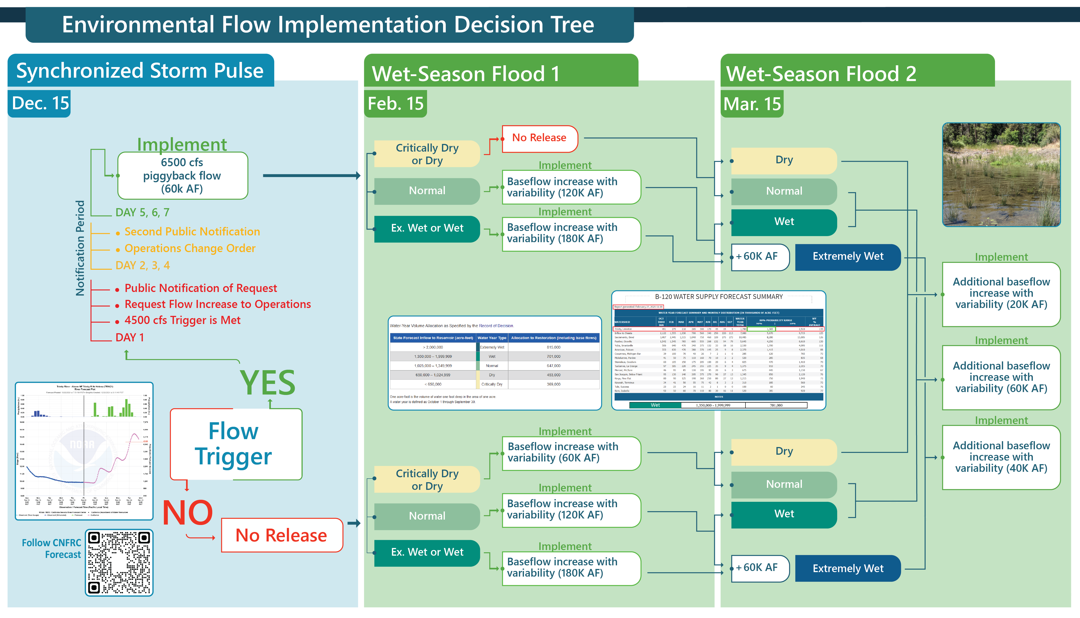
With a Mar. B120 determination of “Dry” the Mar. 15 – Apr. 15 period will increase releases from 300 CFS (winter baseflow) to the Trinity River by adding 20,000 AF into the schedule during this period.
The hydrograph using 20K AF during the next period is the following:
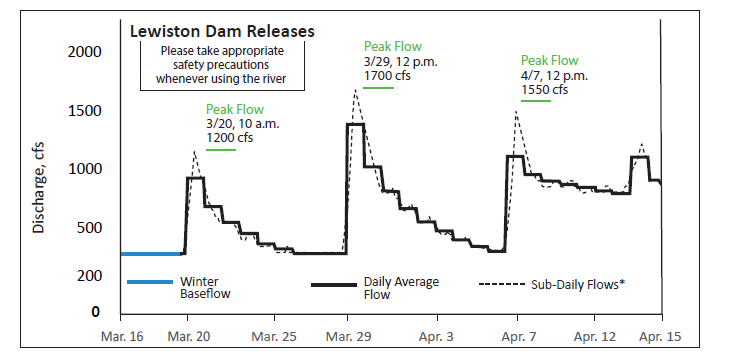
River during the Elevated Baseflow Period (Mar. 15 – Apr. 14).
In April, the Program implements a spring snow-melt and recession hydrograph following the final B120 water year determination by the Department of Water Resources, which is typically announced around Apr. 10.
Trinity Reservoir
Current reservoir data does not play a role in the WY26 forecast or determinations, however levels are important to keep track of and can be accessed by following this link: Trinity Reservoir Daily Data (CDEC) – click the link for daily data.
- Storage on [Mar. 12, 2026]: 2,205,682 AF
- Capacity: 90%
- Historic 15 Year Average (for this date): 129%
- Average storage for [Mar. 12]: 1,7147,721 AF