
For Watershed EA Implementors
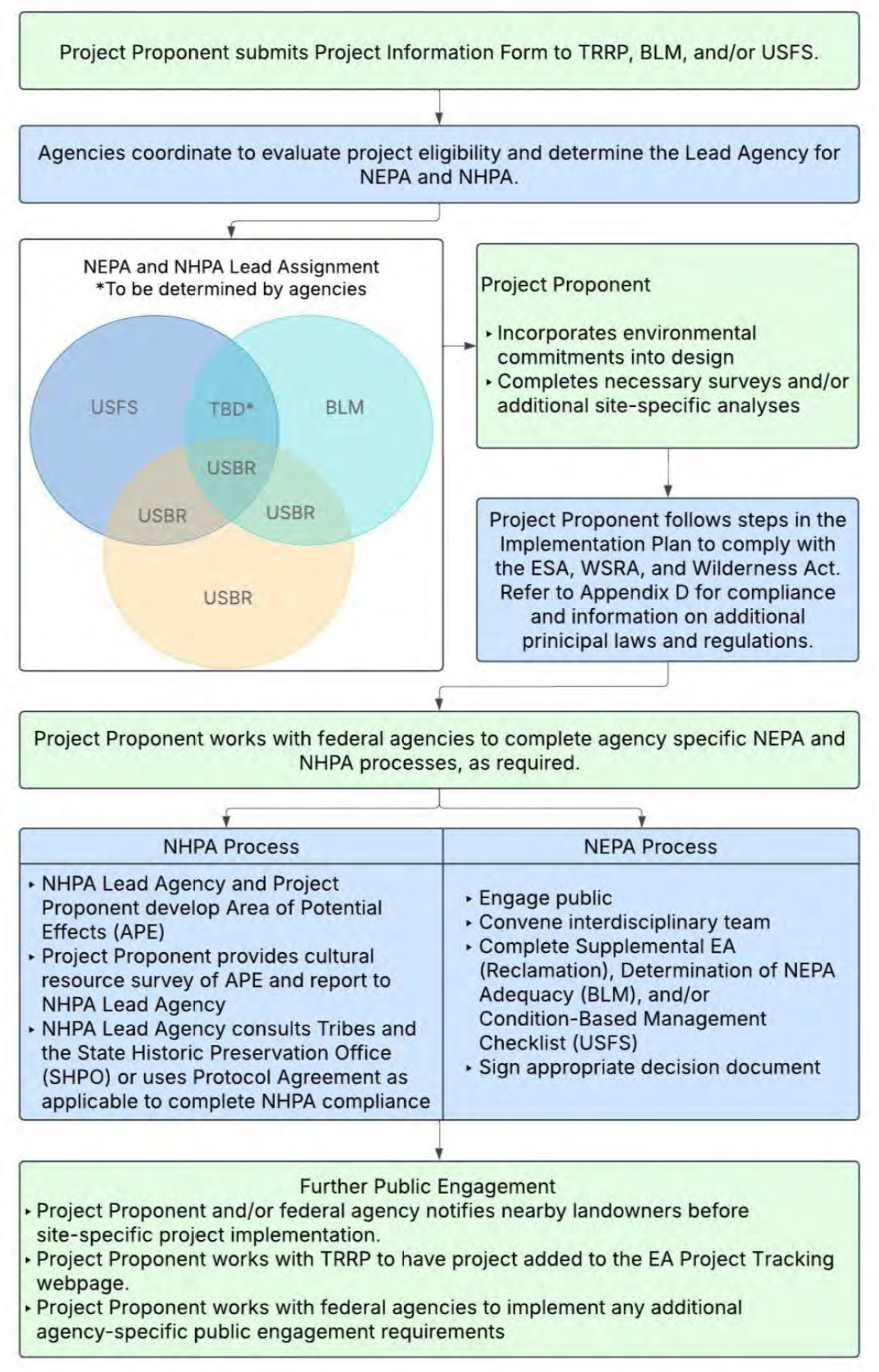
The Watershed Environmental Assessment (Watershed EA) aims to streamline and standardize environmental restoration efforts within the Trinity Watershed, ensuring that projects meet federal environmental standards and contribute to the overall health of the ecosystem. The Watershed EA was written to aid environmental project proponents in conducting restoration activities within the Trinity Watershed. To be eligible for coverage under this document, proposed projects must either be funded with federal dollars or be proposed on federal lands. If this federal nexus is present, project proponents should review the covered restoration activities in Appendix H of the document, which provides activity summaries. These activities are described in greater detail within the main Watershed EA document.
Appendix A, the Implementation Plan, provides the path forward for project proponents which is summarized in the image (Figure 2-1). The submission of the project information form to either TRRP, BLM, or the USFS is the first step in gaining coverage under the Watershed EA.
Please contact info@trrp.net for any questions regarding the Watershed EA activities or the process of attaining coverage under it.
Forms and Templates
- Project Information Form
- Supplemental EA Template (Reclamation)
- Determination of NEPA Adequacy Template (BLM)
- Decision Record Template (BLM)
- Condition-Based Management Checklist (USFS)
- Decision Notification Template (USFS)
Frequently Asked Questions
Several clarifying questions for the Project are discussed below.
How does the California Environmental Quality Act (CEQA) fit in with the Trinity River Watershed Restoration EA?
The EA was prepared to meet the requirements of NEPA only. However, the CEQA Program EIR for the State Water Resources Control Board Statewide Restoration General Order (SRGO PEIR) is available for site-specific project CEQA compliance. The activities covered by the SRGO PEIR were based on the 2022 USFWS Statewide Restoration BiOp and though there are minor differences in what activities are covered by the Project (e.g., road-related site-specific restoration activities), most site-specific projects will be covered by the SRGO PEIR.
How long will the approval process take in order to be cleared to do a project?
The approval process is meant to be streamlined. It would depend on the type of site-specific project being proposed and the lead federal agency process for various environmental compliance components. Much of the environmental compliance approval timeline would be determined by specific processes such as the Section 106 review process and the state and federal permitting process. Early and efficient communication and collaboration combined with a detailed project description and design should lead to a quicker environmental compliance process.
Does each site-specific project have to have 100% designs to be proposed?
The approval process is meant to be streamlined. It would depend on the type of site-specific project being proposed and the lead federal agency process for various environmental compliance components. Much of the environmental compliance approval timeline would be determined by specific processes such as the Section 106 review process and the state and federal permitting process. Early and efficient communication and collaboration combined with a detailed project description and design should lead to a quicker environmental compliance process.
Will the public have the opportunity to provide input on site-specific projects as they are being proposed to be implemented?
These site-specific projects generally include multi-party collaboration for planning and implementation and public notice will be handled by the lead federal agency processes on a case-by-case basis.
Are private lands covered in the Watershed EA?
Private lands are included in the analysis provided in the Watershed EA. It should be noted that, just as for federally managed lands, site-specific surveys and analysis is required for individual projects with federal funding.
Where can I find more information about past restoration work conducted within the Trinity River basin?
The TRRP website has many resources that provide detailed information about restoration activities that have occurred within the Trinity River basin in the past.
Are project activities permitted in designated Wilderness areas?
Project activities may be permitted in designated wilderness areas associated with identifying fish-bearing streams if they are consistent with the Wilderness Act of 1964, USFS policies for wilderness management, and management direction for wilderness management in the land management plan for the Shasta-Trinity National Forest. The process to review project activities proposed in wilderness is described in Section 2.5 of this Implementation Plan. Section 4(c) of the Wilderness Act prohibits certain uses in wilderness “except as necessary to meet minimum requirements for the administration of the area for the purpose of [the Wilderness] Act,” including motorized equipment, mechanical transport, landing of aircraft, structures and installations. If the proposal would involve any Section 4(c) uses, the USFS would conduct a Minimum Requirements Analysis using the interagency Minimum Requirements Analysis Framework tool. Additionally, certain types of activities can only be approved by the Chief of the Forest Service, including fish and wildlife habitat manipulation and watershed condition improvement.
Why do the BLM and USFS have different processes for determining whether site-specific project proposals and effects are within the scope of the EA?
The USFS is using a new approach called Conditions Based Management (CBM). CBM has not yet been adopted by the BLM, therefore BLM will continue to use their Determination of NEPA Adequacy process.